PUDEMO Youth League Remembers Victims of June 2021 Uprising as Eswatini’s Unfinished Struggle for Democracy Continues
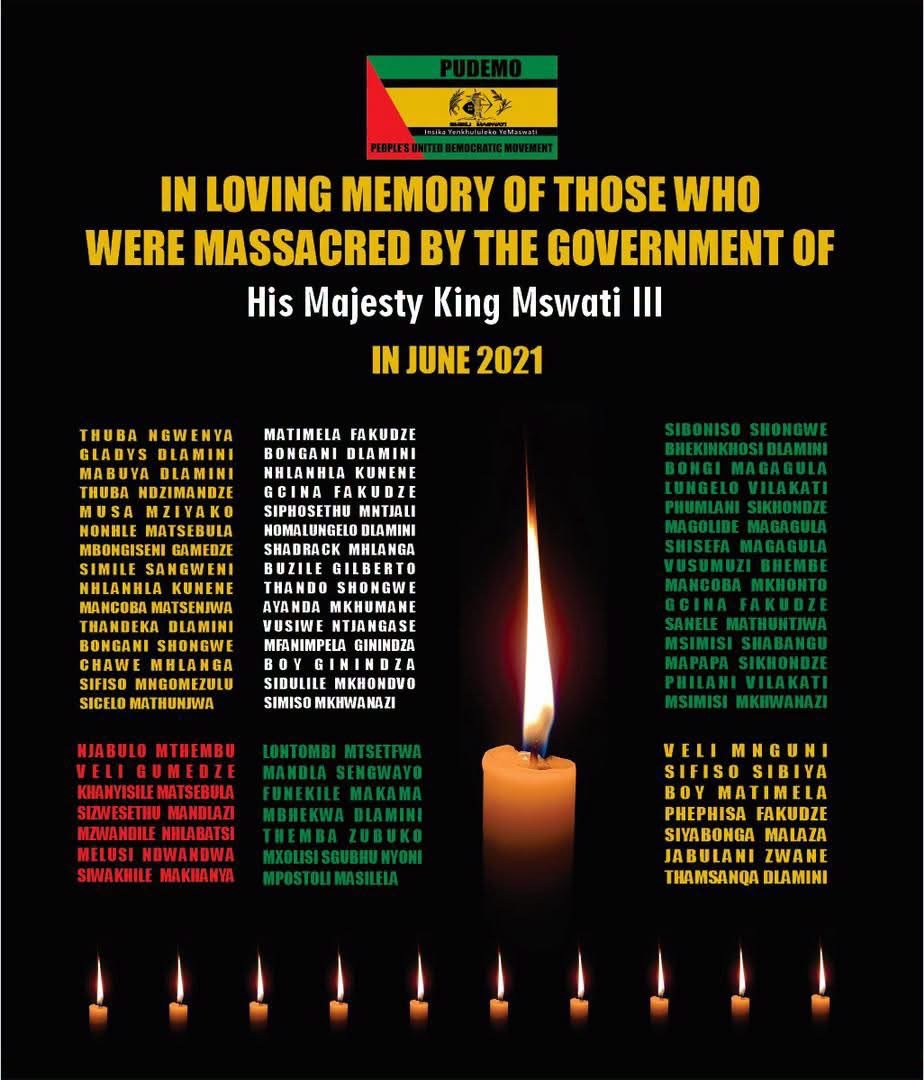
The Youth League of the People’s United Democratic Movement (PUDEMO), the Swaziland Youth Congress (SWAYOCO), has paid tribute to the emaSwati who lost their lives during the June 2021 political uprising, describing the events as one of the darkest and most defining moments in the country’s modern history.
In a statement marking the anniversary of the protests, SWAYOCO honoured those who were killed, injured, tortured, imprisoned, or forced into exile during and after the nationwide demonstrations that shook Africa’s last absolute monarchy.
The youth movement said the sacrifices made by ordinary citizens must never be forgotten.
“On June 29, 2021, Swaziland was plunged into one of the darkest chapters of its history. That day, the voices of ordinary Swazi men, women, and youth rose in courage to demand democracy, dignity, and justice. But instead of dialogue, they were met with bullets, batons, and brutality. We pause today to remember the lives lost during the unrest. We remember the pain, the grief, and the trauma that Swazi families continue to carry. We remember those who were killed, those who were injured, those who were tortured, those who disappeared, and those who remain unjustly behind bars,” the statement reads in part.
The June 2021 protests marked a turning point in Eswatini’s political history.
Although the immediate trigger was public anger following the death of University of Eswatini student Thabani Nkomonye, whose family and many citizens questioned the official explanation surrounding his death, the demonstrations quickly evolved into a nationwide movement demanding democratic reforms.
For years, frustration had been building over unemployment, poverty, inequality, corruption, restrictions on freedom of expression, and the continued exclusion of political parties from participating in national elections.
The petition delivery campaign by Members of Parliament calling for constitutional reforms had already exposed growing public dissatisfaction with the Tinkhundla system. When authorities banned the delivery of petitions and later prohibited public demonstrations, many young people viewed it as further evidence that peaceful avenues for political participation had been closed.
What followed was unprecedented.
Thousands of emaSwati took to the streets across the country, demanding political reforms, accountable governance, and respect for fundamental human rights. While many demonstrations began peacefully, violence later engulfed several towns as businesses were looted and destroyed, security forces were deployed, and confrontations escalated.
Human rights organisations, including Amnesty International and Human Rights Watch, later documented allegations that security forces used excessive force against civilians. Reports alleged that soldiers and police fired live ammunition at protesters and bystanders, resulting in dozens of deaths and hundreds of injuries.
To this day, the exact number of people who died remains disputed.
The Eswatini Commission on Human Rights and Public Administration acknowledged dozens of fatalities in its preliminary findings, while human rights organisations have continued to call for an independent investigation into the killings.
Years later, many families are still waiting for answers.
No comprehensive public inquiry has established responsibility for the deaths, and no senior officials have been held accountable for the alleged use of excessive force during the crackdown.
For many families, justice remains elusive.
The aftermath of the protests also reshaped Eswatini’s political landscape.
Several pro-democracy activists fled into exile after reporting threats to their lives. Others were arrested under terrorism-related legislation. Among the most prominent cases were Members of Parliament Mduduzi Bacede Mabuza and Mthandeni Dube, who were imprisoned after advocating democratic reforms.
Human rights lawyer Thulani Maseko, one of Eswatini’s most respected voices for democracy, was assassinated at his home in January 2023, an event that intensified international concern over the country’s human rights situation. His killing remains unresolved, with international organisations continuing to demand an independent investigation.
Since 2021, international scrutiny of Eswatini has steadily increased.
The United Nations, the African Commission on Human and Peoples’ Rights, Amnesty International, Human Rights Watch, and numerous regional organisations have repeatedly called on the government to investigate alleged human rights violations, protect civil liberties, and engage in genuine political dialogue.
Yet many of the grievances that fuelled the 2021 uprising remain unresolved.
Youth unemployment remains high. Poverty continues to affect a significant proportion of the population. Political parties remain unable to contest national elections, and activists, journalists, and trade union leaders continue to report harassment, arrests, and restrictions on peaceful assembly.
These realities explain why June 2021 continues to occupy such a central place in Eswatini’s political memory.
For democracy activists, the anniversary is not simply about remembering those who died.
It is about remembering why they protested.
It is about recognising that demands for accountable government, freedom of expression, an independent judiciary, and genuine political participation have not disappeared.
The legacy of June 2021 serves as a reminder that lasting peace cannot be built solely through security measures.
History has shown across Africa and the world that sustainable stability is achieved when governments address citizens’ grievances through dialogue, accountability, and respect for human rights rather than repression.
As SWAYOCO commemorates those who lost their lives, the message is clear.
The memories of the victims endure, the calls for justice remain unanswered, and the struggle for a democratic Eswatini continues in the hearts of many who believe that every citizen deserves the right to choose their leaders, speak freely, and live without fear.