King’s Spokesperson Denies Monarch Blocked R500 Million Road Corruption Investigation as Questions Over Accountability Persist
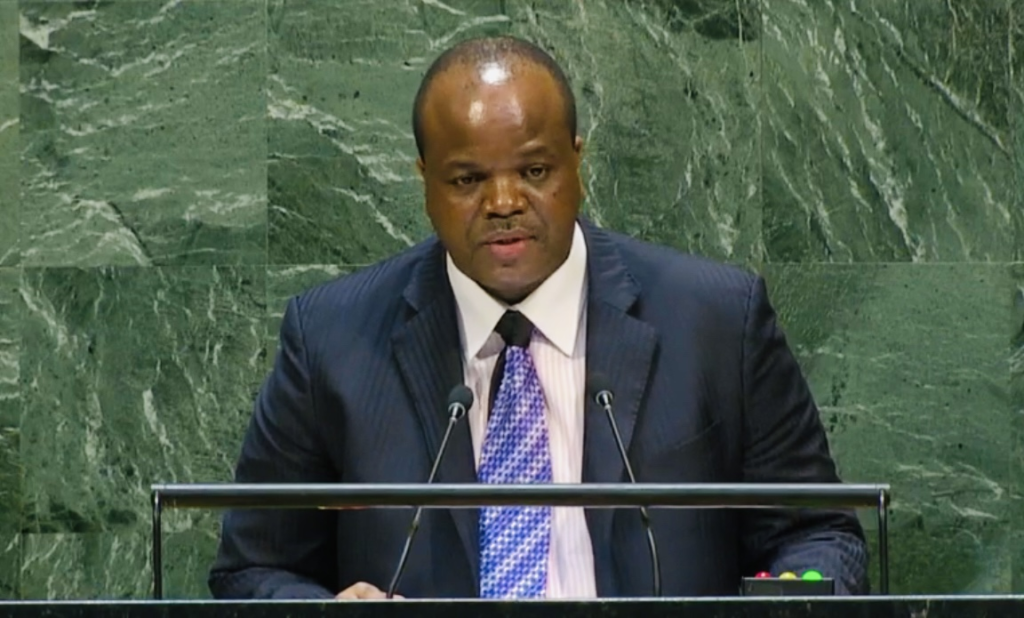
King Mswati III’s Spokesperson, Percy Simelane, has rejected allegations that the Monarch ordered the suspension of investigations into the controversial R500 million Sicunusa-Gege Road project, insisting that no one should accuse the King of protecting corruption without credible evidence.
Simelane was responding after allegations resurfaced linking King Mswati to the halting of the Public Accounts Committee (PAC) investigation into the multimillion-rand road project, one of the most controversial public infrastructure projects in recent years.
The issue returned to the national spotlight after Tinkhundla and Administration Minister Sikhumbuzo Dlamini criticized Parliament for allegedly failing to exercise its constitutional oversight role. During parliamentary proceedings, the Minister questioned why legislators had not demanded progress on the Sicunusa-Gege Road investigation, despite the enormous amount of public money involved.
The renewed debate follows previous claims attributed to Senate President Lindiwe Gwebu-Dlamini, who allegedly stated that King Mswati summoned her together with the late Prime Minister Ambrose Mandvulo Dlamini and then Speaker Petros Mavimbela before directing that the Public Accounts Committee stop pursuing the investigation and discontinue efforts to summon her.
Those allegations have remained politically explosive because they suggest direct royal intervention in Parliament’s oversight functions.
However, Percy Simelane has firmly rejected the claims.
According to the King’s Spokesperson, the only documented position taken by King Mswati has been to encourage the fight against corruption.
He said the King has consistently stated that individuals involved in corruption should be investigated, prosecuted, and convicted where evidence exists, adding that such statements are recorded in Parliament’s official Hansard.
Simelane argued that allegations accusing the Monarch of shielding corrupt individuals have circulated for decades without proof.
He maintained that anyone making such claims has a responsibility to produce evidence rather than relying on speculation or political accusations.
At the same time, Simelane made another significant observation.
He acknowledged that there are individuals within the Tinkhundla system who use the King’s name to advance their own interests, influence investigations, or shield themselves from accountability.
That admission raises an equally serious concern.
If senior officials are indeed invoking the King’s authority without his knowledge to interfere with investigations or manipulate government processes, it exposes deep governance weaknesses within the state.
Whether the Monarch personally intervenes or whether officials merely invoke his name, the outcome is the same if investigations into alleged corruption are delayed or abandoned.
Public confidence suffers.
The Sicunusa-Gege Road project has remained a symbol of the broader accountability challenges facing Eswatini.
Whenever large public infrastructure projects attract allegations of financial irregularities, citizens expect thorough investigations, transparent findings, and appropriate legal action where wrongdoing is established.
Instead, many high-profile investigations have either stalled or disappeared from public view without clear explanations.
This has contributed to growing public skepticism about whether politically connected individuals are held to the same legal standards as ordinary citizens.
Eswatini’s governance structure further complicates these concerns.
As Africa’s last absolute monarchy, executive authority remains heavily concentrated around the King, making perceptions of royal involvement particularly significant. Even when allegations are denied, uncertainty persists if investigations fail to reach clear and transparent conclusions.
The King’s Spokesperson is correct that allegations should be supported by evidence.
The rule of law requires facts, not rumours.
At the same time, the burden also falls on state institutions to ensure that major corruption investigations are completed openly and independently so that the public is not left relying on competing political narratives.
Transparency is ultimately the strongest defence against misinformation.
If the Sicunusa-Gege Road investigation was never improperly halted, then the public deserves to know what became of the investigation, whether anyone was held accountable, and why the matter appears unresolved years later.
The debate therefore extends beyond the question of whether King Mswati intervened.
It raises broader questions about institutional independence, the effectiveness of Parliament’s oversight role, and whether anti-corruption institutions can investigate politically sensitive matters without fear or interference.
Until those questions are answered through transparent legal processes rather than political statements, the controversy surrounding the R500 million Sicunusa-Gege Road project is unlikely to disappear.
For many emaSwati, accountability cannot depend solely on assurances from public officials.
It must be demonstrated through independent investigations, public disclosure of findings, and equal application of the law regardless of status or political influence.