YOU CANNOT FIGHT CORRUPTION WITH CEREMONIES: ESWATINI NEEDS INDEPENDENT INSTITUTIONS, NOT ANOTHER MOU
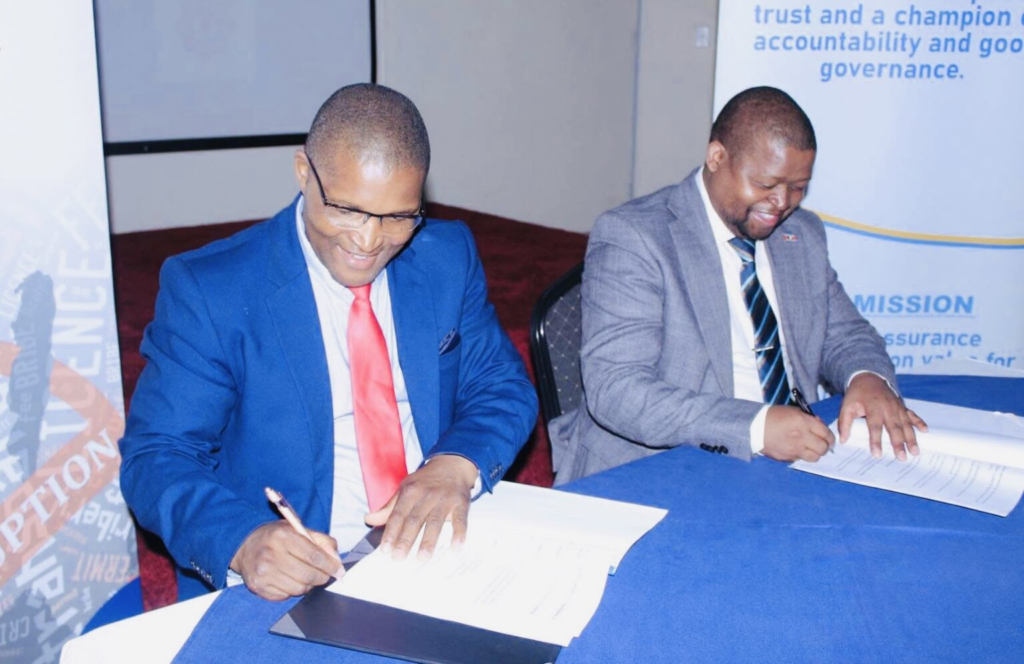
Eswatini’s Anti-Corruption Commission and Office of the Auditor-General have signed a Memorandum of Understanding, promising a stronger partnership in the fight against corruption.
There were handshakes. There were speeches. There were powerful words about accountability, protecting public resources and dismantling corruption.
But emaSwati have heard powerful words before.
What this country desperately needs is not another ceremony announcing that corruption will be fought. It needs institutions capable of following corruption wherever it leads, regardless of the status, political connections or proximity to the monarchy of the people involved.
Auditor-General Timothy Matsebula said the partnership creates a unified mechanism to strengthen accountability and safeguard public resources. He has also acknowledged that corruption can hide inside procurement irregularities, ghost workers, overpriced contracts, unexplained expenditure and weak financial controls.
That diagnosis is important.
But Eswatini’s problem has never simply been an inability to discover irregularities.
Audit reports can expose questionable expenditure. Newspapers can expose scandals. Whistleblowers can speak. Parliamentarians can complain.
Yet corruption survives when exposure does not produce consequences.
The new partnership could improve the movement of information between the Auditor-General, which follows public money, and the ACC, which has statutory powers to investigate suspected corruption. The Prevention of Corruption Act gives the ACC investigative powers and declares the institution independent.
But this is where the political reality becomes impossible to ignore.
The ACC Commissioner is appointed by King Mswati, albeit on the advice of the Judicial Service Commission. The Auditor-General is also appointed by the King, acting on advice from the Finance Minister after a recommendation from the Civil Service Commission. The Audit Act simultaneously declares the Auditor-General independent while saying the Auditor-General administers the office subject to specific or general direction of the King.
That contradiction sits at the heart of Eswatini’s governance problem.
Institutions may be described as independent on paper, but genuine accountability requires more than statutory language.
It requires a political environment in which investigators know that nobody is untouchable.
That is difficult to achieve under an absolute monarchy where enormous political authority remains concentrated around one institution.
Even more revealingly, the Constitution itself places limits around accountability. Section 165 states that the Commission on Human Rights and Public Administration cannot investigate matters relating to the exercise of a royal prerogative by the Crown.
That is why corruption in Eswatini cannot be separated from the struggle for democratic reform.
Corruption flourishes wherever power escapes effective scrutiny.
When political power is concentrated, accountability becomes dependent upon institutions operating inside the very system they are expected to police.
That is not enough.
An ordinary civil servant suspected of stealing public money should face investigation.
A principal secretary should face investigation.
A minister should face investigation.
A politically connected businessman should face investigation.
And proximity to royalty should never become an invisible shield against accountability.
That is what genuine anti-corruption reform would look like.
The Constitution itself declares that lawful measures should be taken to expose and eradicate corruption and the misuse of power by those holding political and public office. Those words should apply without exception.
So let the ACC and Auditor-General cooperate.
Let them exchange information.
Let them follow procurement contracts, ghost workers, unexplained expenditure and missing millions.
But emaSwati should judge this MoU by prosecutions, recovered public money and whether powerful people are subjected to exactly the same scrutiny as everyone else.
Because corruption is not defeated by signing documents at hotels.
It is defeated when stealing from the people becomes dangerous even for the politically powerful.
And until Eswatini builds institutions capable of holding power itself accountable, another MoU risks becoming another impressive piece of paper inside a political system desperately in need of democratic accountability.