KING MSWATI PREACHES DIALOGUE TO THE WORLD WHILE EMASWATI ARE STILL WAITING FOR IT AT HOME
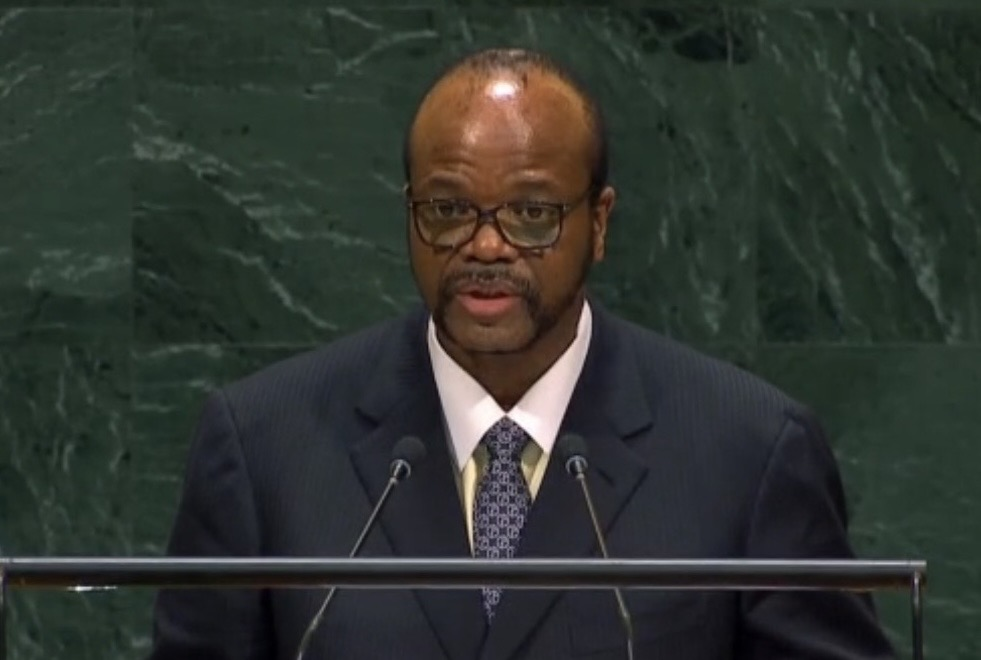
King Mswati stood before the United Nations General Assembly in New York this week calling upon the world to embrace diplomacy, dialogue, peace and constitutional government.
The message sounds admirable.
The uncomfortable part is bringing those same words home to Eswatini.
Reuters confirms that King Mswati addressed the 81st United Nations General Assembly in New York on 23 September 2026. According to reports of his address, the King called for stronger global cooperation, peaceful resolution of conflicts and an end to unconstitutional changes of governments.
There is nothing wrong with that message.
But a ruler cannot preach dialogue internationally while the political system he presides over remains deeply contested at home.
For years, emaSwati demanding fundamental democratic reforms have called for meaningful national dialogue over the country’s political future. They have demanded an elected Prime Minister. They have demanded genuine political participation. They have demanded a political system in which executive authority ultimately comes from the people.
Those demands cannot simply be dismissed as hostility towards Eswatini.
They are political demands about who should govern Eswatini and where political authority should come from.
King Mswati’s own Government acknowledges that political parties cannot contest elections as parties and that candidates participate individually rather than on party platforms. Parliament’s own strategic plan describes the country’s system as a “monarchical democracy” in which citizens elect representatives while the monarchy remains central to political authority.
That is precisely why the King’s message in New York deserves scrutiny.
Dialogue cannot be something Eswatini recommends to governments thousands of kilometres away while struggling to resolve its own political divisions through an inclusive domestic process.
Peace cannot mean the absence of people protesting in the streets.
Peace must include political justice.
Peace must include citizens being able to disagree with their rulers.
Peace must include political opponents being heard rather than treated as threats.
And constitutional government cannot simply mean protecting the existing constitutional order from those demanding change.
A constitution must ultimately serve the people.
The contradiction becomes even sharper when the King warns against unconstitutional changes of government.
Eswatini’s own parliamentary history records that the Independence Constitution provided for pluralist party politics. Parliament’s official strategic plan states that in 1973 the 1968 Constitution was abrogated following parliamentary action and that the King subsequently ruled with a Council of Ministers until the establishment of a new parliamentary arrangement in 1978.
That history matters when discussing constitutionalism.
It reminds us that political systems are not sacred objects frozen forever in time.
They are arrangements created by human beings and they can be challenged, debated and changed by human beings.
The question is whether change comes through genuine democratic participation or whether political authority remains concentrated beyond the effective reach of ordinary citizens.
King Mswati has previously used the same international platform to tell countries experiencing conflict to pursue homegrown solutions and adopt dialogue rather than force. In his 2018 UN address, he explicitly encouraged nations facing disagreements to resolve them through dialogue.
That principle should apply equally to Eswatini.
If dialogue is powerful enough for Sudan, Ukraine, the Middle East and every other troubled corner of the world, then dialogue is powerful enough for Mbabane, Manzini, Siteki and every community across Eswatini.
And genuine dialogue does not mean inviting citizens into a room merely to advise those who already possess power.
It means being prepared to discuss power itself.
It means discussing the future of Tinkhundla.
It means discussing the political powers of the monarchy.
It means discussing an elected Prime Minister.
It means allowing emaSwati to determine the political system under which they want to live.
This is where the King’s words at the United Nations could acquire genuine meaning.
Bring them home.
Let diplomacy begin at home.
Let dialogue begin at home.
Let political tolerance begin at home.
Let the principle that governments derive legitimacy from their people begin at home.
The world does not need another African ruler delivering beautiful speeches about peace from the podium of the United Nations.
Eswatini needs those principles practised inside Eswatini.
King Mswati has told the world that dialogue is the path towards peace.
EmaSwati have heard him.
Now they are entitled to hold those words up against the political reality of their own country.
Because the most powerful speech King Mswati could make about dialogue is not one delivered in New York.
It is one demonstrated at home.