HUMAN RIGHTS WATCH EXPOSES ONGOING ABUSES AND IMPUNITY IN ESWATINI
Human Rights Watch has released a damning report exposing the continued human rights violations in the Kingdom of Eswatini, painting a grim picture of repression, violence, and total lack of accountability under the absolute monarchy. The report, released on Thursday, 30 October 2025, highlights the government’s failure to investigate the killing of innocent civilians during the June 2021 political unrest and the absence of justice four years later.
Eswatini remains an absolute monarchy ruled by King Mswati III, where political parties are banned from participating in elections and dissent is criminalised. Human rights defenders, activists, and ordinary citizens who demand democratic reforms are routinely arrested, tortured, or killed. According to Human Rights Watch, the lack of political will to address past abuses continues to fuel fear and anger among the population.
The report recalls that in June 2021, Eswatini experienced a sharp deterioration in its human rights situation. Pro-democracy protests erupted following the killing of 25-year-old University of Eswatini student Thabani Nkomonye, whose death was widely linked to alleged police brutality and impunity. What began as outrage over one killing quickly evolved into nationwide, youth-led demands for democratic reforms and accountability.
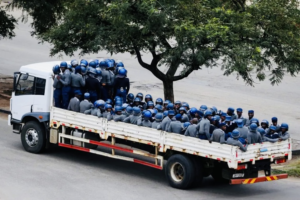
Human Rights Watch notes that while the protests were largely peaceful at the beginning, they escalated towards the end of June after the government adopted a hardline response. Authorities banned demonstrations, prohibited the in-person delivery of petitions to state institutions, closed schools for extended periods, and deployed heavily armed security forces to suppress dissent. These measures, the report argues, were aimed not at restoring order but at crushing legitimate political expression.
Based on 15 interviews conducted in 2025, the report corroborates earlier findings that the Royal Eswatini Police Service and the Umbutfo Eswatini Defence Force used excessive and unlawful force during the unrest. Security forces fired teargas and rubber bullets, physically assaulted civilians, and in many cases shot indiscriminately with live ammunition at protesters and passers-by. Scores of people were killed, hundreds were injured, and children were among the victims.
Human Rights Watch stresses that these killings were not accidents but the result of deliberate and reckless use of lethal force. Yet, years later, not a single perpetrator has been held accountable. Victims and their families continue to live with physical injuries, psychological trauma, and economic hardship, while those responsible enjoy protection and silence from the state.
The report also refers to a preliminary investigation released on 29 October 2021 by the Eswatini Commission on Human Rights and Public Administration, which confirmed that at least 46 people were killed and 245 sustained gunshot injuries, including 22 who were shot multiple times. Even then, the Commission admitted that the figures likely underestimated the true scale of the violence.
Despite victims identifying members of the police and armed forces as the shooters, the Commission declined to name perpetrators in its preliminary report. Human Rights Watch notes with concern that, as of now, no final report has been released, reinforcing perceptions that the investigation was deliberately stalled to shield those responsible.
According to Human Rights Watch, the failure to investigate and prosecute these crimes has entrenched a culture of impunity in Eswatini. The report warns that without accountability, abuses will continue, and citizens will remain unprotected against state violence.
The findings confirm what emaSwati have long known: that under an absolute monarchy, justice is selective and human rights exist only on paper. As long as the killings of 2021 remain unresolved, Eswatini cannot claim stability or peace. Instead, it stands accused before the world as a state that kills its own people and refuses to confront the truth.
Human Rights Watch has called for urgent action, including independent investigations, accountability for security forces, reparations for victims, and genuine democratic reforms. Until these demands are met, the wounds of June 2021 will remain open, and Eswatini’s human rights crisis will continue unabated.